

2-Rescuer BLS with an AED: Roles, Timing & Teamwork
Posted by Sydney Pulse, APRN at 8:28 am 0 Comment Print
A cardiac arrest gives rescuers only minutes to act. Every minute without CPR or an AED shock cuts survival odds by about 10%. That single fact explains why two trained rescuers working as a team often save more lives than one rescuer working alone. This guide breaks down how 2-rescuer BLS with an AED actually works, from first compression to first shock.
What Is 2-Rescuer BLS with an AED?
Two-rescuer BLS with an AED is a coordinated team response to cardiac arrest. One rescuer manages chest compressions. The other rescuer handles the airway, delivers breaths, and operates the AED. This division of labor keeps compressions faster, deeper, and more consistent than one person can manage alone.
The approach follows the American Heart Association’s 2025 Guidelines for CPR and Emergency Cardiovascular Care. It applies anywhere two BLS-trained people might respond together. Hospitals, dental offices, schools, gyms, and workplaces across Columbus all fit that description.
Rescuer Roles in a Two-Person Response
Clear roles prevent confusion during a crisis. Rescuer One kneels beside the patient and begins chest compressions right away. Rescuer Two opens the airway, delivers rescue breaths, and calls for the nearest AED.
Together, the team follows a 30:2 compression-to-breath ratio. The AHA reaffirmed this ratio in its latest guideline update for both lay rescuers and healthcare professionals, until an advanced airway is placed.
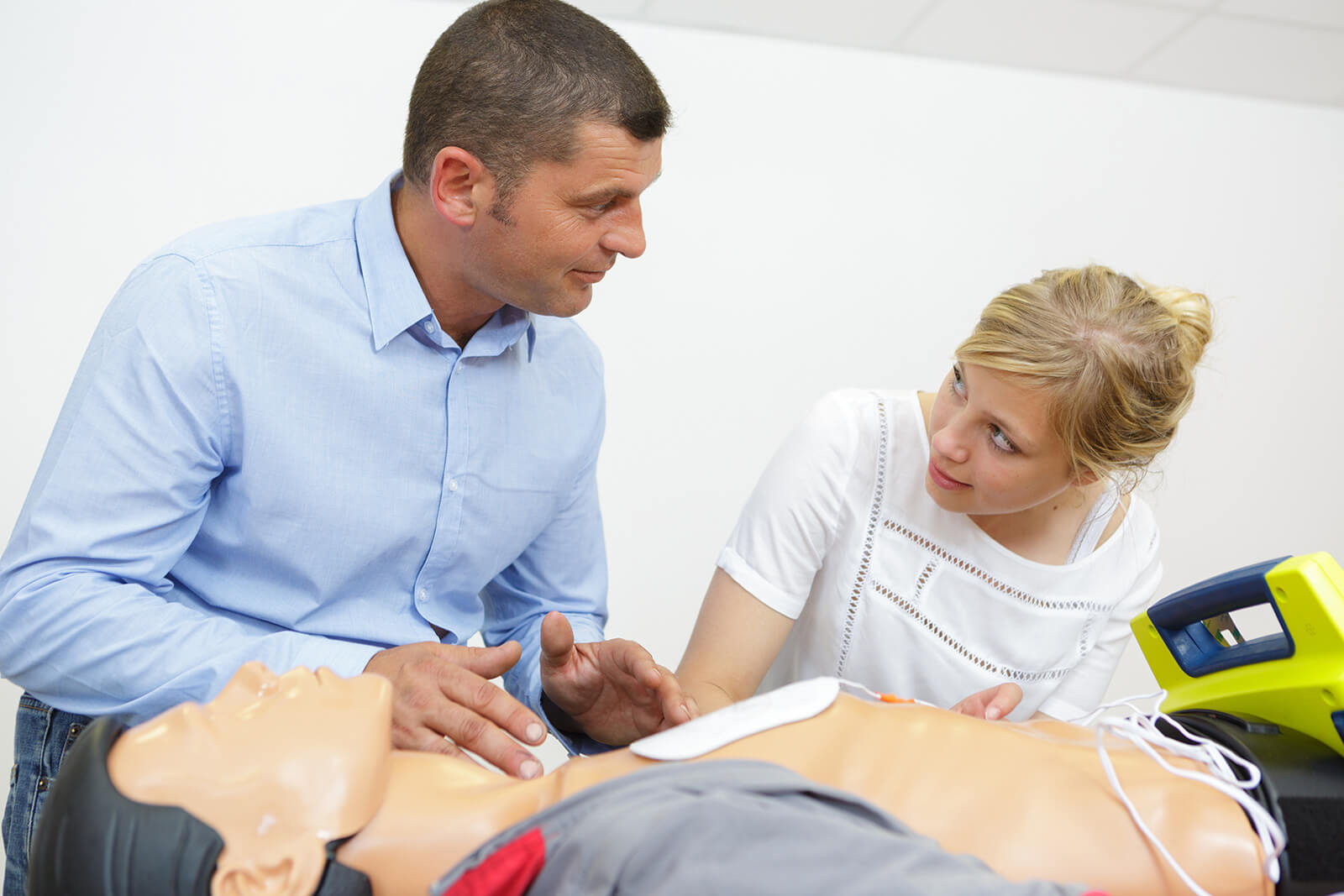
Once the AED arrives, Rescuer Two applies the pads while Rescuer One keeps compressing. Pausing compressions for pad placement should take only a few seconds. Every extra second without compressions lowers blood flow to the brain and heart.
When and How to Switch Roles
Fatigue sets in fast during chest compressions, often before a rescuer even notices it. Compression depth and rate start slipping within two minutes for most people, even trained providers.
AHA guidance calls for a role switch every five cycles of CPR, or roughly every two minutes. The switch itself should take less than five seconds. A fast, quiet handoff during the AED’s rhythm check keeps interruptions short and compressions nearly continuous. This timing detail separates textbook two-rescuer CPR from the real, high-performance version taught in AHA classes.
Where the AED Fits Into the Sequence
The AED should power on and attach as soon as it’s available, ideally within the first couple of minutes of arrest. Rescuer Two places the pads while Rescuer One continues compressing. Once the device starts analyzing the heart rhythm, both rescuers step back from the patient.
After a shock, or a “no shock advised” message, compressions resume immediately. This tight loop, compress, analyze, shock or resume, defines high-performance two-rescuer BLS with an AED. Skipping steps or hesitating at this stage is one of the most common errors instructors see in practice drills.
Why Two Rescuers Improve Survival Odds
National data backs up the team approach. The 2025 CARES National Registry found that 42.5% of cardiac arrest patients received bystander CPR last year, the highest rate recorded since 2016. Bystander AED use in public settings climbed to 13.9%, also a record high. Communities that pair fast CPR with early defibrillation see survival odds approach 50% for patients found in a shockable rhythm.
Ohio still has room to close the gap. Statewide bystander CPR rates hover near 33%, below the national average, and Franklin County data points to a similar shortfall. More trained rescuers in Columbus means more patients get compressions and a shock before EMS arrives.
Local hospital systems feel this gap directly. OSU Wexner Medical Center, OhioHealth, Mount Carmel Health System, and Nationwide Children’s Hospital all depend on staff who can run this two-person sequence without hesitation. The same skill matters outside the hospital, too, in dental offices, daycare centers, fitness facilities, and any workplace with more than one BLS-trained employee.
Common Mistakes to Avoid
A few small errors show up again and again in practice sessions. Rescuers sometimes stop compressions too early, well before the AED finishes its rhythm analysis. Others forget to announce the switch out loud, which causes both rescuers to hesitate at once. Shallow compressions after a switch are common too, since the new compressor often takes a few seconds to find the right depth and rate.
Good communication fixes most of these problems. Calling out compression counts, announcing “switching now,” and confirming “all clear” before a shock keeps both rescuers synced. These habits feel awkward at first. They become second nature after a few rounds of guided practice.
Building the Skill Through Hands-On Practice
Reading about role switches and AED timing only goes so far. Muscle memory comes from repetition on a manikin, with a real partner, under real time pressure. AHA-aligned BLS classes build this skill through scenario drills. One student compresses, one manages the airway and AED, and both practice the handoff until it feels automatic.
Modern training manikins include feedback devices that show compression depth and rate in real time. That instant feedback helps rescuers fix bad habits before they matter in an actual emergency. Group classes also mirror how most workplace cardiac arrests really unfold, since a coworker, not a stranger, is usually the second rescuer on scene.
Ready to Practice 2-Rescuer BLS with an AED?
Two-rescuer BLS with an AED is a skill that sharpens with hands-on repetition, not passive reading. CPR Columbus, an American Heart Association training site, teaches this exact sequence in small, stress-free, hands-on classes using real manikins and AED trainers.
Sign up for CPR certification Columbus if you’re starting from scratch and want the foundational skills. Prefer the healthcare provider-level course for work or licensure? Enroll in BLS certification Columbus instead. Either path leaves you ready to lead or confidently join a two-rescuer response the moment it matters most.
